Complete Guide to Warehouse Racking Systems for Glass and Window Manufacturing

Most glass manufacturers lose money every week from broken sheets, slow material handling, and wasted floor space, and the root cause is almost always the same: racking that wasn't designed for glass.
Standard warehouse shelving wasn't built for large, fragile, heavy sheets. If you've ever had glass slip off a shelf, crack during a move, or had workers strain themselves lifting oversize panes, this guide is for you.
Why Warehouse Racking Systems Are Critical in Glass & Window Manufacturing
Did you know? The global warehouse racking market was valued at around $9.71 billion in 2024 and is expected to reach $12.41 billion by 2030.
There is this rapid growth because of the demand for better warehouse storage solutions. With this, manufacturing industries have realized the importance of storing materials properly, as it directly affects productivity, safety, and operational costs.
Fragile and High-Value Materials
As glass sheets and window units are heavy, large and fragile, they can’t be kept like regular products. One has to be careful when stacking them to prevent cracks and scratches.
Safety Risks Without Proper Storage
If there is improper storage, such as floor stacking or leaning glass against walls, it can pose severe safety hazards to workers. Also, the risk of breakage increases.
Better Organization and Workflow
Well-designed industrial racking systems help organize materials properly, making it easier to move glass from receiving to production and shipping.
Maximizing Warehouse Space
The right warehouse racking systems help manufacturers use vertical space effectively and keep warehouse floors clean, organized, and efficient.
Types of Industrial Racking Systems

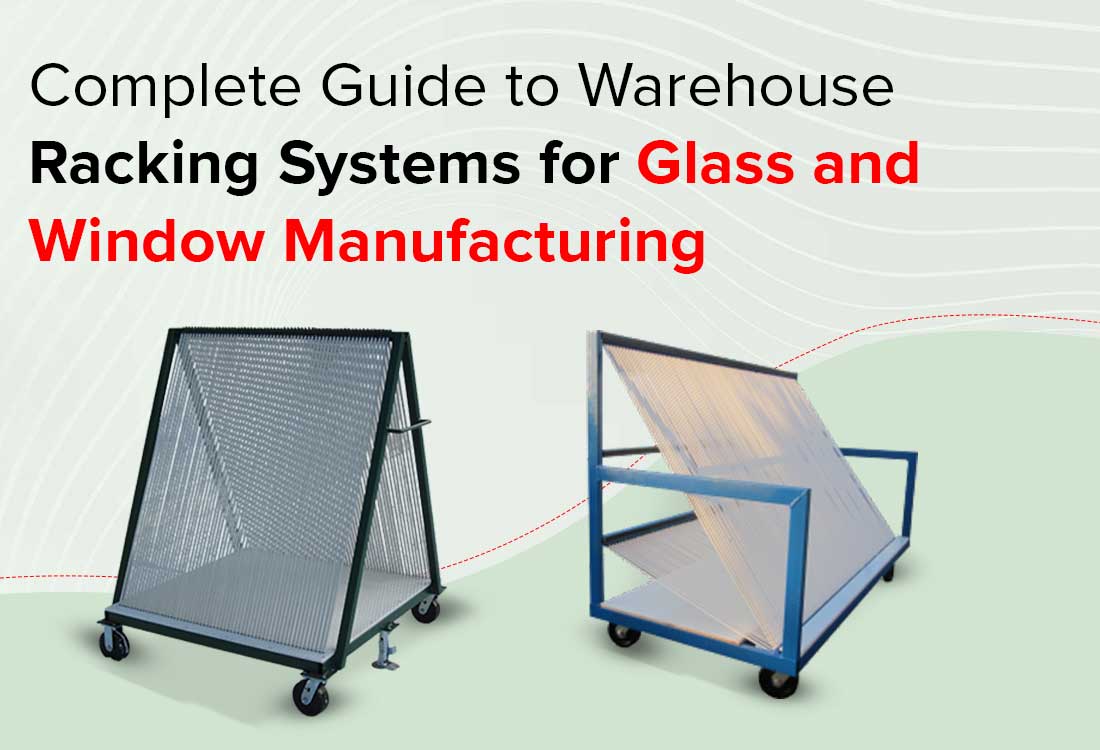
A-Frame Racks
These are the most commonly used racks in glass and window manufacturing. The rack has an ‘A’ shape, making it possible for glass sheets to lean safely on both sides. This way, the panel remains stable, with minimal to no risk of breakage.
L-Frame Racks
L-frame racks are ideal for warehouses with limited space. These racks are commonly used in glass factories where materials need to be stored close to cutting, processing, or packaging areas.
Drawer-Type Glass Racks
Drawer-type racks work like large sliding drawers. Each drawer holds glass panels and can be pulled out when needed. This system makes it easier for workers to access specific glass sheets without moving other panels, reducing damage during handling.
Mobile Racking Systems
Warehouses have tracks installed on their floors, and these racking systems move on them. Instead of fixed aisles, racks slide to open the aisle only when needed. This way, businesses can store more while keeping access easy for workers and equipment.
Cantilever Racks
These racks have long horizontal arms, which make it possible for them to hold huge and bulky materials. Also, its open design allows forklifts to load and unload materials quickly.
Harp Racks
Harp racks are commonly used in the glass industry for the safe and organized storage of glass sheets and insulated glass (IG) units. They feature multiple slots designed for specific glass thicknesses, separated by PVC-covered steel rods to help prevent scratching and damage. This design keeps each sheet secure while allowing for easy access when needed.
How to Buy Warehouse Racking: Step-by-Step
If you follow the steps below, you can avoid buying the wrong racking system.
Write down what you're actually storing
It is always better to note down the size of the largest glass sheet, the heaviest one, and the longest extrusion you regularly handle. Doing this will help you determine the minimum arm length and load rating you need.
Measure your available space
Measure the floor area, ceiling height, and also the forklift aisle. If it happens to be less than 10 feet, you will require a narrow-aisle solution or maybe a different rack configuration.
Calculate Your Peak Storage Needs
When planning your storage, think about your busiest period of the year. How many glass sheets or extrusion lengths do you need to store during that time? Your warehouse racking system should always be designed for peak inventory levels, not the average.
Decide: new, used, or custom?
Used warehouse racking for sale can cost 40–60% less than new, great for pallet racking and extrusion racks. For glass-contact racking, inspect every arm carefully and replace any worn padding before use. Custom fabrication is worth it when standard sizes don't match your specific glass dimensions.
Get three quotes and compare the total cost
Include delivery, installation, floor anchoring, and padding materials in every quote. These extras can add 20–40% to the rack price itself. A cheaper rack with expensive installation often isn't cheaper overall.
Check your floor before you order
Heavy-loaded racking puts significant weight on your concrete slab. Some rack types, such as drawer systems, may also require the entire unit to be anchored directly to the floor. If you're unsure your floor can handle it, especially for tall cantilever systems, get a structural engineer to check. This is far cheaper than dealing with a cracked floor after installation.
4 Practical Tips to Get More Out of Your Warehouse
Tip 1: Divide Your Warehouse by Work Stage
All these require different types of handling – raw glass, glass in processing, finished windows, and shipping items. If you provide a dedicated storage area for each, the warehouse will look more organized and be easier to work in.
Tip 2: Use Vertical Space
You must have noticed how almost all warehouses use only the lower part of the building. This leaves behind a lot of unused space above. But if you install taller racking systems, or have racks and dollies that can stack up, you can increase the storage capacity, without expanding the floor area
Tip 3: Label Every Rack Clearly
The best thing you can do is label everything. Doing this will help workers find the right items instantly, so they do not have to waste time roaming the warehouse.
Tip 4: Choose Versatile Racks
You’ll thank us for this later: whenever possible, choose versatile racks. If you have the option to use the same rack for storage, in-shop material handling, or shipping, it is often the better investment. A multi-purpose rack gives you more value upfront and more flexibility if your needs change over time.
The Bottom Line
Growth in glass and window manufacturing often brings a hidden challenge – storage that can’t keep up with production. As orders increase, warehouses quickly fill with large glass panels, frames, and finished products. Without the right structure, teams waste time moving materials around, and the risk of costly breakage goes up.
This is the reason why industrial racking systems are gaining popularity. If you think you need to better your setup with durable industrial racking, Kear Fabrication Inc. can help.
Frequently Asked Questions
How often should I inspect my racking?
Do a quick visual check weekly and a thorough documented inspection monthly. Focus on arm connections, anchor bolts, any bending or deformation, and the condition of protective padding.
What safety features should glass storage racks have?
It is crucial for glass storage racks to have protective padding, strong anchor points, and stable support arms. Having these prevents glass from slipping and reduces the risk of damage, creating a safer environment for people.
How long do industrial racking systems typically last?
High-quality industrial racking systems can last for many years when properly installed and maintained. Regular inspections, proper loading practices, and timely repairs help extend the racking system's life.