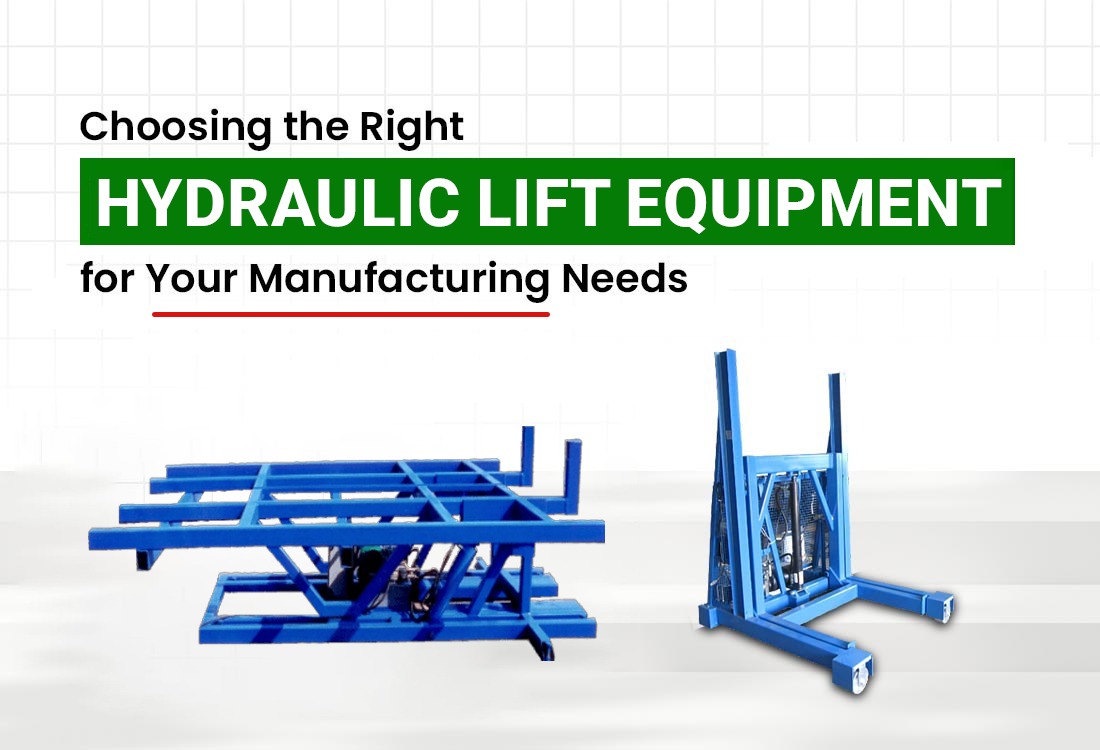
Choosing the Right Hydraulic Lift Equipment for Your Manufacturing Needs

If we talk about manufacturing, you need equipment that
- keeps things moving smoothly
- takes care of workers' safety, and
- does not slow down production
That is why it is crucial to have the right hydraulic lift equipment. However, the issue arises when you have to choose one among the many options available. Especially for those who are not familiar with industrial equipment, the options can get overwhelming fast.
So, through this guide, we’ll help you pick the right equipment for your needs. Whether you're running a small fabrication shop or a full-scale manufacturing facility, we are here to make things easy for you.
What Exactly Is Hydraulic Lift Equipment?
Hydraulic lift equipment refers to heavy-duty material-handling solutions built with hydraulic power to help you:
- Lift heavy items
- Move them around your workspace
- Position them at the height you need
Think of it as a strong, reliable helper that:
- Doesn’t get tired
- Doesn’t need training
- Never complains about the weight
It’s designed to take the physical strain off your team while keeping operations efficient.
Why Manufacturers Rely on Hydraulic Lift Equipment
Manufacturing never really sits still. Materials come in, components move from one station to another, machines need maintenance, and finished products head out the door. Hydraulic lift equipment keeps this entire flow running smoothly by doing the heavy, repetitive, and height-based work humans shouldn’t have to do.
Worker Safety: Instead of employees trying to lift or shift 200–500 lb parts on their own, hydraulic systems take over that strain. Less manual lifting means fewer injuries, less fatigue, and safer workdays overall.
Efficiency: Because the equipment handles both weight and movement, tasks are faster and require fewer hands. What once needed two or three people can often be done by one trained operator.
Precision: Many manufacturing processes need items placed at exactly the right height or angle. Hydraulic lift equipment allows fine-tuned adjustments at the push of a button or lever, making setups accurate and safe.
Versatility: These systems aren’t limited to one material or one type of job. Whether your floor handles metal sheets, machine components, moulds, bins, pallets, or specialty parts, hydraulic lift equipment can lift, position, and transport them without fuss.
A Real-World Example
Take facilities that work with glass crates but don’t have enough ceiling height for tall forklifts. Equipment like the hydraulic lift low headroom free fall solves this problem by letting workers load crates using a pump truck or L-frame dolly and then raise them to the exact working height — all without needing extra vertical clearance.
In short: hydraulic lift equipment boosts safety, speeds up workflow, and gives manufacturers the control they need. A win-win for both productivity and people.
How to Choose the Right Hydraulic Lift Equipment for Your Manufacturing Needs
 Choosing the right hydraulic lift equipment becomes much easier when you focus on a few key factors. Here’s everything explained in simple, practical terms.
Know Your Load Capacity Needs
Always begin by clarifying the weight you deal with daily. Ask yourself -
- What’s the heaviest item you’ll place on the lift?
- Do your loads change often, or are they mostly consistent?
Hydraulic lift equipment ranges from 500 lbs to several tons, so you want to pick one that can comfortably handle more than your actual load.
Rule of thumb: Choose a lift with 20–30% extra capacity. This gives you room for future changes.
Consider the Platform Size
Since the platform carries the load, its size affects both safety and efficiency.
- A too-small platform creates balance issues.
- A too-large one becomes difficult to maneuver in tight spaces.
Choose a platform that:
- Holds your biggest load comfortably
- Provides extra stability
- Moves easily through aisles or between machines
If your materials vary a lot (sheet metal vs. round components), pick equipment with a platform that accommodates different shapes.
Choose the Right Lift Height Range
Every hydraulic lifting system has a minimum and maximum height. The right range depends on where you’re lifting from and where you’re placing the load.
Ask yourself:
- Are you lifting from the floor, a pallet, or a conveyor?
- Do you need to reach a machine bed, a welding table, or a rack?
A proper height range helps reduce bending, reaching, awkward movements, and workplace injuries.
Real-world example: In places with low ceiling clearance, the free fall rack with hydraulic lift allows loading glass crates low to the ground and lifting them to the required height — without high-reach forklifts.
Wheel Type Matters More Than You Think
Wheels seem like a small detail, but they impact how smoothly and safely your equipment moves.
- Polyurethane wheels: Quiet, great for smooth-coated floors
- Rubber wheels: Shock-absorbing, ideal for uneven floors.
Choosing the right wheels also protects your flooring.
Manual vs. Electric Hydraulic System
Now decide how you want the equipment to operate.
Manual hydraulic systems
- work through a foot pump
- Affordable
- Low-maintenance
- Best for small to medium workloads
Electric hydraulic systems
- Battery or power-operated
- Much faster lifting
- Ideal for heavy, repetitive tasks
If your team uses the equipment dozens of times daily, electricity saves time and reduces physical strain.
Look for Safety Features
Choose hydraulic lift equipment with proper safety features such as:
- Locking wheels
- Overload protection
- A wide, stable base
- Non-slip platforms
These prevent rolling, tipping, and accidental overloads.
Customization Options (A Big Advantage)
Hydraulic lift equipment really proves its worth when you need something built around your workflow. Companies like Kear Fabrication can tweak almost anything — platform size, frame strength, wheel type, lift height, even extra safety add-ons.
They’ll even build custom platforms for odd or delicate materials. All these small changes make daily work smoother, faster, and way more efficient, while giving you better long-term value.
Putting Safety and Workflow First
When you’re choosing hydraulic lift equipment, the right pick should make your daily workflow easier, safer, and far more reliable. As your manufacturing needs grow, your lift should grow with you, too. So don’t just think about load capacity or lift height — also look at maintenance, warranty, replacement parts, and how smoothly the equipment fits into your current setup.
These small details save you a lot of headaches later. In the end, the best lift is the one that supports your team, protects your operations, and keeps everything moving without stress.