Transfer Conveyor vs Power Conveyor: Which Performs Better in Continuous Glass Production?

Glass production lines move fast, and if the conveyor system cannot keep up, everything starts slowing down. With a wrong system, there can be issues like broken glass, production delays, material buildup, and extra downtime that quickly affect the entire line. That is why manufacturers pay close attention to the type of conveyor they use. Transfer conveyors and power conveyors both do the same basic job, but they work very differently once production is running nonstop. And that difference is exactly what this guide breaks down.
Understanding Transfer and Power Conveyors in Glass Manufacturing
Transfer Conveyor
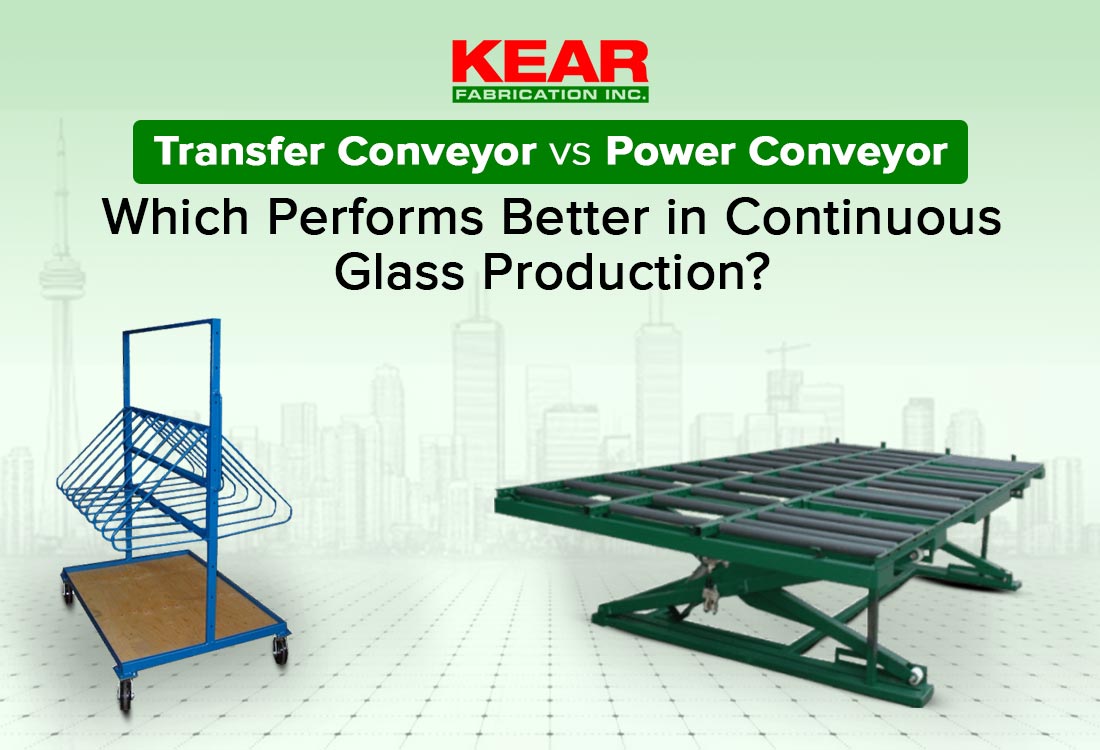
A transfer conveyor does exactly what the name says. It transfers glass from one conveyor line to another, whether that means changing direction, moving to a different process station, or handing the glass off to the next stage of the line. In glass industries, this usually involves lifting rollers or shuttle systems that pick the glass up from one line and place it onto the next. It is built for those in-between moments, not for running the entire production line continuously.
How Transfer Conveyors Work
Most transfer conveyors use rollers, belts, or chain based systems to guide the glass forward at a controlled pace. The movement feels much more controlled compared to heavy high speed conveyor setups. That matters because glass sheets can still be hot, freshly coated, or sensitive around the edges while moving through the line. A rough transfer can leave scratches, chips, or alignment problems before the product even reaches the next stage.
Common Applications in Continuous Glass Production
You will usually find transfer conveyors around cutting tables, inspection areas, tempering sections, and packaging stations. They are especially useful when glass needs proper positioning before another machine takes over. For example, after cutting, the sheet may need to line up perfectly before inspection or edge processing begins.
Advantages of Transfer Conveyors
The biggest reason manufacturers use transfer conveyors is control. They help keep glass movement smooth and stable while taking up less space inside the production line. They are also a better fit for coated or decorative glass where surface damage can quickly turn into rejected products.
Limitations of Transfer Conveyors
Transfer conveyors are not built for every situation. They are usually less effective for moving glass over long distances, and some setups struggle in very high speed production environments where nonstop throughput matters more than precision.
Power Conveyor
A power conveyor works differently. It keeps the glass moving the whole time, from one end of the process to the other, without any stops or handoffs in between. Motorized rollers or belt drives maintain a steady, controlled speed throughout. In continuous glass production, you will find power conveyors running through the most critical stages like annealing, tempering, and float glass lines because in those processes, stopping the glass even briefly can ruin the entire batch.
Common Applications in Continuous Glass Production
Power conveyors are mostly used in bigger glass facilities where products need to move across longer sections of the plant. You will usually spot them in float glass production, tempering lines, coating areas, and packing sections where the goal is to keep production running continuously with as little interruption as possible.
Advantages of Power Conveyors
What manufacturers like most is the production speed. These systems can handle large glass volumes without slowing the line down every few minutes. They also reduce a lot of the back-and-forth manual handling, which is why they fit well inside automated production setups.
Limitations of Power Conveyors
The downside is that these systems are heavier and more expensive to manage. They also need proper setup because if the movement feels too aggressive, thinner or delicate glass can become harder to handle safely.
Transfer Conveyor vs Power Conveyor: Key Differences Explained
When people search for this comparison, they usually want a straight answer. So here is how these two systems actually stack up against each other in a real glass production environment.
Speed and Throughput Performance
A power conveyor runs at a steady, controlled speed the whole time. No pauses, no slowdowns, no gaps in the flow. That is what continuous glass production needs.
A transfer conveyor stops briefly every time it moves glass from one line to another. In a smaller or semi-automatic setup that is fine. But in a high-volume continuous line, those small stops add up and start affecting the overall output.
Glass Handling Precision and Product Safety
Vibrations, rough handoffs, or sudden speed changes can cause micro-cracks in glass that only show up later.
A power conveyor keeps the glass on one smooth surface the entire time, no pickups or drop-offs mid-run.
A transfer conveyor lifts and places the glass at every line change. That handoff moment is where most surface damage and rejections happen.
Automation Compatibility
Power conveyors connect directly with PLCs, speed sensors, and variable frequency drives. The entire line can be monitored and controlled from one point without stopping production.
Transfer conveyors can be automated, but every transfer point needs its own timing and sensors. More transfer points mean more things to sync and more chances for something to go wrong.
Maintenance Requirements
Power conveyors have fewer moving parts across the line so there is less to inspect, less to replace, and less that can go wrong during a production run.
Transfer conveyors have multiple handoff points and each one has its own rollers, sensors, and mechanical parts. More components means more maintenance stops and a higher chance of something failing mid-shift.
Energy Consumption and Operational Costs
Power conveyors run continuously but modern ones use variable frequency drives that adjust energy use based on the actual load. So they are not burning full power the whole time.
Transfer conveyors use energy in bursts every time they activate at a handoff point. Across a full production shift with multiple transfer points running, those bursts add up on the energy bill.
Long term, power conveyors tend to cost less to run even though the upfront investment is higher.
Flexibility and Production Layout Adaptability
Transfer conveyors actually have an edge here. They are designed to change direction, work at different angles, and connect lines that are not running parallel. If your production layout is complex or changes often, transfer conveyors give you more flexibility to work around it.
Power conveyors are built for fixed, straight, continuous runs. They are harder to reconfigure once installed and work best in layouts that do not change much.
The Real Question: Which One Works Better for Your Production Line?
Honestly, it comes down to how your production line operates day to day. Let’s get an idea of whether you need a transfer conveyor or a power conveyor, depending on what your line demands:
When are Transfer Conveyors the Better Choice?
Not every glass line runs the same way. If your facility has multiple process stations, tight corners, or areas where glass needs to change direction, transfer conveyors are built exactly for that.
They are also a better fit when you are handling coated, decorative, or thinner glass where one rough handoff can damage the whole sheet. Inspection zones, cutting tables, and packaging areas are where transfer conveyors do their best work.
When are Power Conveyors the Better Choice?
If your facility runs glass production continuously without stopping, a power conveyor is what you need. Float glass lines, tempering furnaces, and annealing lehrs cannot afford interruptions and power conveyors are built to handle exactly that.
They also make more sense when you are dealing with high volumes, longer production runs, and a layout that does not require frequent direction changes. The bigger your operation, the more a power conveyor pays off.
The Last Thing You Need to Know Before Choosing
Both conveyor systems have their place in glass manufacturing. The right choice comes down to what your production line actually demands. If you are unsure which system fits your setup, talking to experts at Kear Fabrication Inc. in Canada before making a decision can save you a lot of time and money down the line. We can help you find the right conveyor solution based on your actual glass production needs by contacting us through our website.