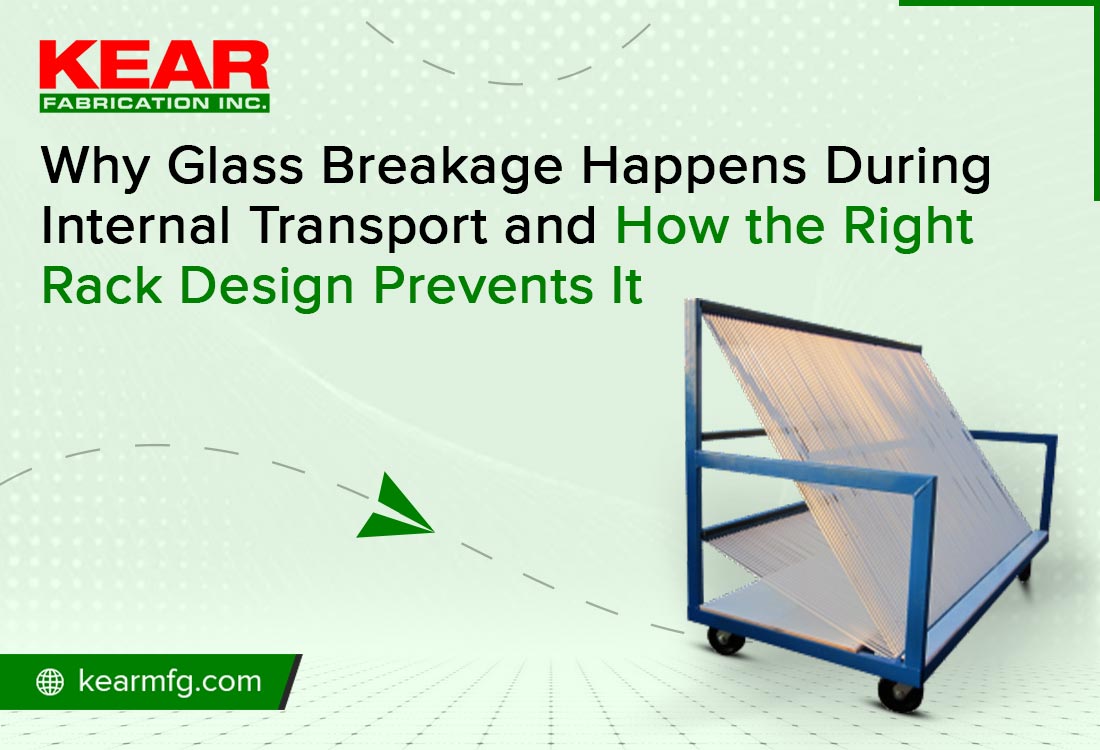
Why Glass Breakage Happens During Internal Transport and How the Right Rack Design Prevents It

One cracked panel can derail a full production schedule, eat into your margins, and start a blame game that nobody really wins. It happens more often than most facilities are willing to admit, and almost always in places nobody is watching closely enough.
The delivery truck gets blamed first, then the road conditions, then the loading crew. But a significant chunk of glass damage actually happens inside the facility itself, during routine internal movement, handled by your own team on your own floor.
The truth is, internal glass breakage is rarely accidental. It points back to a systems gap, and more often than not, the rack design is where that gap lives.
The Real Reasons Glass Breaks Before It Even Leaves the Building
Most facilities spend considerable energy protecting glass during outbound shipping. Bubble wrap, corner guards, careful loading. But the damage often starts long before the truck backs into the bay. Internal transport is where glass takes its first hits, and because the distances are short, the risks feel invisible until they aren't.
Vibration From Forklifts and Floor Surfaces Does More Damage Than You Think
Forklifts are not gentle machines. Even at low speeds, they produce consistent vibration that travels directly into the glass, stressing edges and creating hairline fractures that aren't always visible to the naked eye. On top of this you have sudden accelerations, rough concrete joints and uneven flooring. Tempered and coated glass varieties are especially vulnerable because their internal tension makes them sensitive to repeated micro-stress.
Glass Touching Glass Is Almost Always a Problem
When panels are loaded without proper dividers or padding, contact between sheets becomes inevitable during movement. That contact causes surface scratches at best and stress fractures at worst. Leaning glass at the wrong angle adds pressure along the bottom edge, which is already the most vulnerable point during transit.
Human Error Rarely Gets Talked About Honestly
Sharp forklift turns, rushed loading, distracted operators moving through tight spaces. These are daily realities in busy facilities, and glass does not forgive them. What makes this particularly difficult is that stress damage builds silently. A panel that looks fine after a rough move may fail hours later during handling or installation, making the root cause nearly impossible to trace back.
How Rack Design Directly Influences Glass Survival Rates
Once you understand where the damage actually comes from, the conversation about rack design stops feeling like a procurement decision and starts feeling like a damage control strategy. The right rack doesn't just hold glass upright. It actively works against every failure point that internal transport introduces.
Tilt Angle Is a Small Detail That Carries a Lot of Weight
Most people don't think twice about the angle at which glass sits in a rack, but they should. The ideal tilt range sits between three and five degrees from vertical. This distributes the panel's weight evenly along the bottom edge rather than concentrating pressure at a single stress point. Facilities running racks outside this range are essentially setting glass up to fail before it moves an inch.
Padding and Dividers Eliminate the Contact Problem Entirely
Quality transport racks use rubber or plastic padding on base supports and foam or dividers with plastic coverings between panels. These materials do two things simultaneously. They prevent glass-on-glass contact during movement and absorb the vibration that forklifts and floor surfaces constantly generate. It's a straightforward fix that dramatically reduces both surface damage and edge fracturing.
Frame Rigidity Matters More During Movement Than During Storage
A rack that feels stable while stationary can flex considerably under forklift movement. That flex translates directly into glass movement, which creates exactly the kind of micro-stress discussed earlier. Welded steel frames hold their geometry under load. Bolted frames loosen over time and introduce wobble that most operators never connect back to their breakage rates.
What to Look for When Choosing a Glass Transport Rack
Buying a glass transport rack based on price alone is one of the more expensive decisions a facility can make. The breakage costs that follow a poor rack choice almost always outweigh whatever was saved upfront. Here's what actually matters when evaluating options.
The Bottom Support Has to Match Your Glass Dimensions
Wide, padded base supports that run the full length of the panel are non-negotiable. Narrow or undersized supports concentrate load unevenly and create pressure points that cause edge damage during even routine movement.
Divider Spacing Should Match Your Standard Panel Widths
Racks with fixed dividers that don't align with your glass sizes create lateral movement between panels. That movement is constant during transport and cumulative in the damage it causes. Adjustable divider systems solve this without requiring multiple rack types across the facility.
The Rack Needs to Move Without Being Unloaded First
This is where many standard racks fall short. A transport rack that requires glass to be unloaded before forklift movement defeats its own purpose. Look for frames engineered specifically to carry loaded glass from one point to another without compromising panel stability mid-transit.
Custom Sizing Is Worth the Conversation
Non-standard glass dimensions are common across fabrication and architectural projects. A rack supplier that offers size customization is an investment that pays back quickly when breakage rates drop within the first few weeks of use.
Small Rack Changes That Can Reduce Glass Losses Immediately
Not every fix requires a full rack replacement. Some of the most effective changes cost very little and can be implemented within a single working day.
Inspect all rack padding regularly and replace any foam, plastic, or rubber that has hardened or compressed beyond its original thickness
Post maximum panel capacity visibly on every rack because overloading is almost always a training gap, not a policy gap
Add rubber stops to the bottom rail if your current rack doesn't already have them
Enforce slow-speed movement zones wherever glass racks are actively in transit
Make rack inspection part of weekly equipment checks, not an afterthought saved for after something breaks
The Right Rack Is Not an Expense. It's a Loss Prevention Strategy.
Internal glass breakage is a controllable problem. It doesn't require a complete operational overhaul to fix, just an honest look at where your current handling system is letting glass down before it ever reaches the customer.
Start with one rack, one production line, one slow-speed zone. The improvements compound quickly once the right systems are in place.
Kear Fabrication Inc. offers custom glass transport racks built for real handling conditions and real glass dimensions. If breakage is quietly eating into your margins, let's talk about what the right rack design can do for your operation.